
Jefferson County Arrest Records and Court Charges
A Jefferson County arrest record is the law enforcement account of an arrest. It names the agency that made the arrest, the date, the booking details, and the offense the officer alleged at the time. The Jefferson County Sheriff's Office, the Waurika Police Department, or the Oklahoma Highway Patrol may each make arrests in the county. None of them decide the formal charge. That job belongs to the prosecutor. After an arrest, the District Attorney for District 6 reviews the case and decides which state charges to file in District Court. Once those charges are filed with the Court Clerk, they become the court charge record.
The two records do not line up by default. The arrest and booking side stays with the sheriff or the city police, and current custody is best checked through the jail roster rather than the court docket. For booking detail and custody status, the county's inmate records page covers that channel. Court charges after arrest are tracked through the case itself. Each count carries a statute number, an offense level, and a status that can change. Arrest records tell you who was taken into custody. Charge records tell you what the state chose to file.
How to Find Jefferson County Arrest Records and Charges
The court charge record is searched online through Oklahoma's two main case portals. The Oklahoma State Courts Network, known as OSCN, lists Jefferson County District Court in its docket search court dropdown. On Demand Court Records, or ODCR, also carries Jefferson County and allows name searches. Booking and arrest detail is not in these court systems. That information sits with the arresting agency and the jail.
- Open OSCN docket search and select Jefferson County District Court from the court dropdown, or open ODCR and choose Jefferson.
- Search by defendant name in Last, First order, or enter a case number if you have one.
- Open the case and read the charge list, noting the case prefix such as CF for a felony or CM for a misdemeanor.
- Check each charge's statute, count number, level, and current status in the docket entries.
Basic arrest and booking facts can be public in Oklahoma even before charges are filed. Under the state Open Records Act, law enforcement agencies must make certain arrest, jail, and incident details available, while investigative narratives stay exempt. You can read the law-enforcement records rule, 51 O.S. Section 24A.8, which lists what an agency must release.
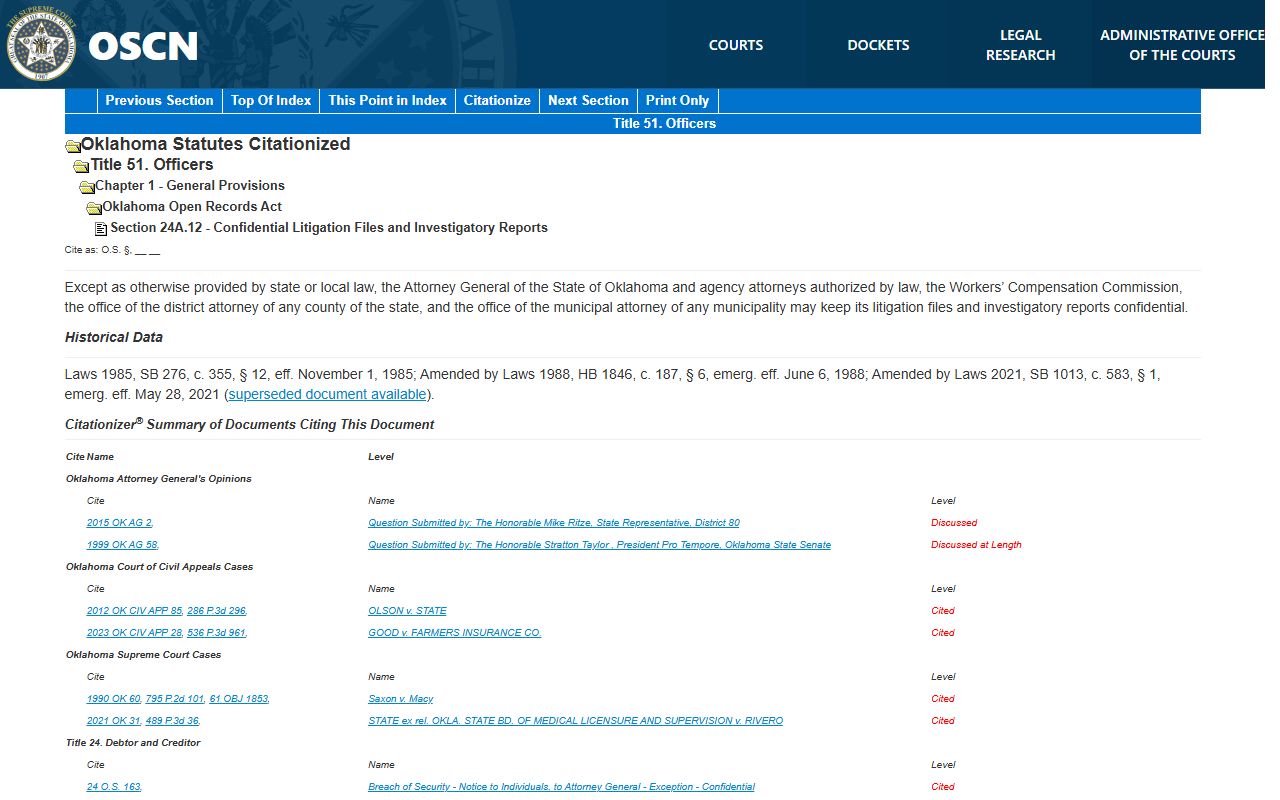
The statute draws the line between a public booking fact and a sealed investigative file. That line is why an arrest can appear in the public record before any charge is filed. Note: OSCN and ODCR show the court charge record, but neither posts booking photos or the arresting agency's full investigative file.
How Charges Get Filed: Complaint, Information, and Indictment
The court charge record begins when a charging document is filed. An arrest alone does not create a court charge. In Jefferson County, most cases start with a complaint or an information signed by the District Attorney, while the most serious felonies can come through a grand jury indictment. The charging document names each count, cites the statute, and states the level of the offense.
| Complaint | Information | Indictment | |
|---|---|---|---|
| Filed By | Officer / Prosecutor | Prosecutor | Grand Jury |
| Common For | Misdemeanors | Many felonies | Serious felonies |
| Starts | The case | The case | The case |
Who Files Jefferson County Charges and What Happens First
The District Attorney decides the state charges, not the arresting officer. Jefferson County sits in Oklahoma District Attorney District 6, led by District Attorney Jason Hicks, with a county office inside the courthouse in Waurika. After reviewing the arrest and the evidence, the office can file the charges an officer alleged, file different counts, add counts, or decline to file at all. The booking allegation and the filed charge are not always the same.
Once charges are filed, the defendant has a first appearance, often called an arraignment. The judge states the counts, sets or reviews bond, and enters an initial plea. These early entries show up in the docket as the case opens. A warrant can also issue at this stage when a person has not yet been arrested or fails to appear.
Recent local cases show how an arrest can move into the charge system. In 2025, an Oklahoma State Bureau of Investigation inquiry led to the arrest of a Waurika officer and a Jefferson County dispatcher, reported by local news.
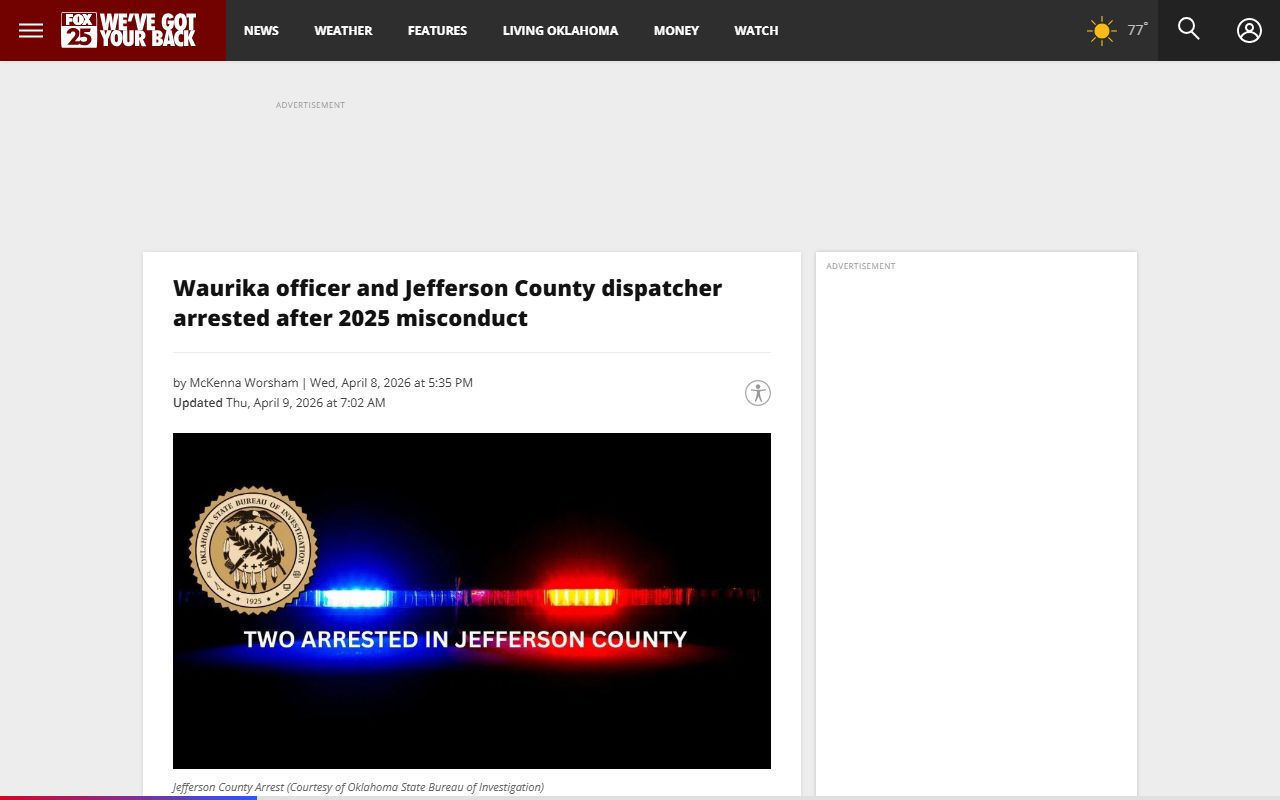
An arrest like that becomes a court charge only after a prosecutor reviews it and files counts in the proper court. The arrest may generate a booking record and an agency report right away, but the charge record waits on the filing decision.
Jefferson County Charge Status Explained
Charges are not fixed once filed. As a case moves, a count can be amended, reduced, dropped, or dismissed. The docket records each shift, so the status you see today may differ from the charge filed at the start. Oklahoma prosecutors can also enter a nolle prosequi, which means they choose to dismiss a charge and not pursue it.
| Status | What It Means |
|---|---|
| Filed | The prosecutor entered the charge and the case is now active. |
| Pending | The charge is open with no final result yet. |
| Amended / Reduced | The charge was changed, often to a lower level or a different count. |
| Bound Over | After a preliminary hearing, a felony is sent forward for trial. |
| Dismissed | The court ended the charge without a conviction. |
| Nolle Prosequi | The prosecutor chose to drop the charge and stop pursuing it. |
Note: A status entry can change quickly, so the docket you read today may not reflect a hearing or filing made only hours later.
Jefferson County Charge Codes and Severity
Each charge ties to a specific Oklahoma statute, and the case number carries a prefix that signals the level. Felony cases use the CF prefix. Misdemeanor cases often use CM. A felony is the more serious class and can carry prison time. A misdemeanor carries lighter penalties, such as jail time of up to a year, a fine, or both. One arrest can produce several separate counts, so a single booking may show up as more than one charge in the same case.
Reading the prefix helps you sort what a case involves:
- CF: a felony charge filed in District Court.
- CM: a misdemeanor charge filed in District Court.
- TR: a traffic case.
- CV: a civil case.
- PO: a protective order matter.
Charges vs. Convictions in Jefferson County
A filed charge is an accusation, not a finding of guilt. A conviction comes only from a guilty plea, a no contest plea, or a verdict. Many charges never reach a conviction, since they get reduced, dismissed, or dropped along the way. The full path from charge to outcome, including the plea and any sentence, is laid out in the county's criminal court records.
| Charge | Conviction | |
|---|---|---|
| Stage | Accusation | Verdict or plea |
| Burden of Proof | Probable cause | Beyond reasonable doubt |
| Public Record | Yes | Yes |
Statewide Charge and Criminal History Lookups
A county docket shows the charge in one case. A statewide criminal history pulls charges together across Oklahoma courts. The Oklahoma State Bureau of Investigation, known as OSBI, runs the official state criminal history record check. For sentenced state inmates, the Oklahoma Department of Corrections offender lookup shows custody status and offense summaries. Neither tool is a county jail roster, and each carries its own access rules and fees.
These statewide systems matter because a Jefferson County case may not be a person's only one. Charges from other counties, state prison custody, and supervision status sit in different databases. A single docket search does not capture that wider picture. A reduced charge in one county and a dismissed charge in another can both shape how a record reads, yet neither shows up if you stop at one court file. Note: The Department of Corrections warns that its offender data is abbreviated and is not a complete account of any sentence or charge.
Sealed vs. Expunged Charge Records
Some charge records can be sealed or expunged. Sealing hides a record from public view. Expungement goes further and treats parts of the record as if they never existed. Oklahoma law sets who qualifies under Title 22, and the process usually starts with a petition in the District Court where the case occurred. The OSBI expungement guidance explains the fees and timing for clearing an arrest record.
| Sealed | Expunged | |
|---|---|---|
| Visibility | Hidden from public | Destroyed / treated as never existed |
| Law Enforcement | Limited access | Very limited |
| Eligibility | Set by 22 O.S. Section 19 and court order | Set by 22 O.S. Section 18; OSBI fee for arrest records |
Background Checks and Charge Records
A casual name search and a formal background check are not the same. Employers, landlords, and licensing bodies that use a report for a decision must follow the federal Fair Credit Reporting Act, which sets accuracy and notice rules. A quick docket lookup carries no such protections, and it may be out of date. Charges that were later dismissed or reduced can still appear in old data, so confirm the current status against the court file before relying on it.
Important: This site is a private resource, not a consumer reporting agency under the FCRA, so its information cannot be used for credit, employment, tenant, or insurance decisions.
Restricted Charge Records in Jefferson County
Not every charge record is open. Juvenile charges are generally confidential under Oklahoma law and rarely appear in a public search. Sealed and expunged charges drop out of public access once a court grants the order. Charges tied to an active investigation can be withheld, and sensitive details such as victim addresses, minor names, and personal identifiers are redacted from public filings.
A dismissed or dropped charge adds another wrinkle. The court may withhold or restrict access to some closed matters, and an expunged charge will not appear at all once the order is granted. A missing online result is not proof that no arrest or charge ever happened.
When an online search comes up empty, the record may still exist. Older Jefferson County cases may not be digitized, a file may be sealed, or the name format may be off. The Court Clerk can confirm what the court file holds. The Jefferson County Court Clerk, Kimberly Berry, is at 220 North Main Street, Waurika, OK 73573, and the office line is 580-228-2961. Call to confirm hours and current copy fees before visiting or mailing a request.